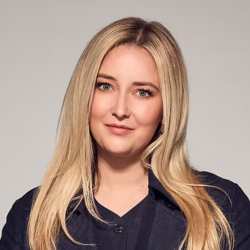
Morgan is Spotify's first EQUAL podcast ambassador — this interview has been lightly edited for style and readability
James Cridland: You host Two Hot Takes. Tell us about that. It’s a big show. It’s been in the Edison Research Top 50. Uh, what’s the show about?
Morgan Absher: I like to describe it as a modern day Dear Abby, a relationship advice column. We’re pulling stories from the internet, and our own subreddit and reacting to people’s crazy life problems, giving them advice and creating a sense of community and village for people to deal with their problems and come together and crowdsource solutions and advice.
JC: What made you start doing that show?
MA: It was a total accident. The biggest random blessing of my life. I moved from Minnesota to Los Angeles for grad school. I graduated April 2020 with a doctorate in occupational therapy, but the pandemic was hitting, and so I couldn’t get a job in healthcare. I applied to hundreds of places. So I told my boyfriend at the time - now my husband - that I was on Reddit constantly, I got nothing else going on, and I thought, what about a podcast? I can’t keep sending these to my friends every day. They have jobs, they’re working. So he bought me all of the equipment, taught me how to edit, and I just hit the ground running. And it blew up overnight.
JC: Very cool. You’ve been doing video for a long, a long while on both Spotify and on YouTube. How has video been for you?
MA: I started video day one. In February 2021, the very first episode always had video. And it’s really been the sole reason I’ve grown as quick and as big as I have. Especially for reaction type content, people want to see the people, they want to see the faces, the jaws dropped. I think video adds just such a another big component and also makes you feel more real and that sense of community too, if you can see the person and really feel like you’re connecting with them.
JC: You’re also with PAVE Studios, you’re doing a true crime show called Clues, and you won a Webby for that. Did you pick up the award yourself?
MA: I did! I have it now.
JC: What was your five-word speech? Can you remember?
MA: I was basically just thanking the listeners. “We did it thank you”, something like that. Both shows wouldn’t exist without the listeners. So I’m always just very thankful.
JC: So Spotify’s extending its EQUAL program; until now that has supported women in music. It’s now also supporting women in podcasting, and you are the first EQUAL podcast ambassador. Why is that important to you, Morgan?
MA: It’s huge. It just still feels surreal. I don’t really have all the words to kind of encompass how I’m feeling.
When I started podcasting, the first place you look is the charts, and you’re wondering how do I do it as well as the people at the top? And there weren’t very many women. Crime Junkie and Ashley Flowers was really my blueprint, but beyond that, there wasn’t many women at the top. And so to start having more inclusion and a way to amplify women-led podcasts, just really helps.
Even if you look at the top 100 today, there was that Annenberg study that came out - still the top 100 are mostly men, even though women are listening to more episodes every week. I think a program like this really helps kind of get us on an even playing field and makes the success stories a lot easier to come by.
And I hope to hear more of them.
JC: What should the industry be doing better, do you think, for women’s equity?
MA: There needs to be more events and community-building things. Early on in my career it was really hard to get guests, especially guests that were at a higher level than me and could help cross-pollinate and promo the show. Spotify puts on a lot of good events - something as small as just a social meetup for people that are podcasting, or you know, they have Jordan Newman come in. He’s like, here’s your show art and your cover art, and here’s how you hack the system and make it so your art speaks and helps grow your show. I think more partners need to do that. There’s still not a lot of transparency out there, you know, that speaks to ’this is what I did, exactly how I did it, and here’s how you replicate it'.
JC: Who do you look up to in terms of um podcasting?
MA: I would say Ashley Flowers is a big one. I really love NPR’s Life Kit, which has a variety of hosts, but I feel like more of the the journalistic style and like the storytelling of it, I really love. I love Relationsh*t with Kamie Crawford. We’ve got Hannah Berner, from Giggly Squad. My co-host on Clues, Kaylin Moore. She is absolutely remarkable. I genuinely think, you know, she’s probably up there with me on how hard we’re working. She has such a drive and an ability to research well and tell these unique stories. So she is someone I really look to as well.
JC: You mentioned that the top seems to be mostly blokes. Why do you think that is? We know that women listen to podcasts just as much as men do. So why do you think that the men have risen to the top of the charts?
MA: It might be a little bit of a hot take, but - confidence. I think as a woman, I really doubted myself. I doubted my ability to be able to do this. Am I good enough to do a show? Who’s gonna listen? I think there’s a a lot more imposter syndrome. I think a lot of people now are claiming that podcasting’s oversaturated. And I think that’s so opposite. I think now more than ever is the time for women to start podcasts, and climb our way up there, because there’s there’s just a demand for it based on all the listening stats we’ve been seeing. Radio also has been more historically male-led shows. I think it’s just that time’s kind of catching up and maybe a little bit historical and maybe a little confidence.
JC: There are a ton of um really useful events now going on. The International Women’s Podcast Awards, which you can enter - we’ve got a week left to enter that. I hope that you’ll be entering that too. Do you think that specific awards like the International Women’s Podcast Awards and specific events for women are useful, or is it more of a case of just making sure that big events like Podcast Movement, for example, are as diverse as they possibly can be in terms of gender, but in terms of other parts as well?
MA: I think it’s a little bit of both. I think these award shows help get eyes and you know, notoriety, recognizability, on these shows. Looking at my Webby categories - I’m like, I’ve never heard of this. Then you listen and you’re like, wow! Thank God this show got put on this platform because otherwise, I’m living under a rock and I never would have known. I think those awards are great to add credibility - I won an award. Oh, Morgan’s the real deal. I’m gonna go on her show. So I think it it really helps there. And I think the Podcast Movements as well, and the speakers and the panels and the topics they cover, I think that really moves the needle as well.
JC: Super cool to speak to you. Thank you so much.
MA: Yeah, thank you!