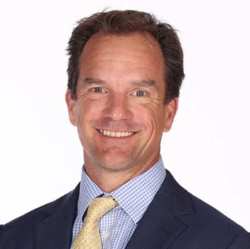
David Locke is the founder of the Locked On Podcast Network — this interview has been lightly edited for style and readability
James Cridland: Next week you celebrate 10 years of the Locked On Podcast Network. Congratulations. What was the first show that you did?
David Locke: Locked On Jazz was the first show I was the host, and I also did Locked On NBA. So I was the first of the two hosts that existed on the show. Then we got the NBA and the NFL loaded up and launched. I think Locked On Bowls might have been the very first show that I was not the host of.
JC: Locked On Jazz is about the Utah Jazz, rather than music. Why get into podcasting then in in the first place?
DL: I’m the radio announcer for the Utah Jazz, so that’s my other job. I also was a program director of sports talk radio, and had moved to Seattle to be a sports talk show host. I think when podcasting came, I was really looking for just a vehicle. I didn’t think, as a play-by-play announcer, you could just call 82 games and call it good. I thought you probably needed to communicate with your fans 365 days a year, or at least close to it in some capacity in the new world, with Twitter and Facebook and all the things that were exploding at the time. But I didn’t really know what I was doing.
The first one’s still up on YouTube. I clearly had no clue. We did Google Meets for a while, then we did Google Hangouts for a while. That went wrong because there’s no control of who gets into Google Hangouts and people did profane things! It wasn’t until 2016, is where then I’d been doing that for a few years. I’d launched Locked On NBA, and I just realized that there was there was something here.
If you go back to the program director days, we used to have these national shows like Jim Rome and Dan Patrick. They would be on 65 different stations across the country, but do one ad sale. We flipped it and said - we’re gonna get 30 NFL shows, but we’re gonna sell it as one product. And so that’s how we still sell today. If you’re buying advertising on Locked On, you’re buying one of five shows. You’re buying the NFL, the NBA, Major League Baseball, the hockey show, or our college sports show. So we are selling to a client the largest NFL show on the market, and one of the largest NBA shows on the market, and probably the largest baseball show on the market, with the numbers that we have in a given day at this point, 10 years later. But that was the model from the beginning. That just was very different than what anyone was doing, and somehow it worked.
JC: How do you do the quality control for 275 daily shows? You can’t possibly have a listen to every single one of those, I guess.
DL: AI helps us a great deal at this point. We also just have an incredible staff. So as we’ve built this out, we now have managers of every channel, and the audio and video director, and talent scouting. Our goal is to be the single most talent-friendly network in the country. I want us to treat the talent better than anyone out there. And I think we do - we support them amazingly, we give them incredible resources, we coach them to get better, we have a lot of systems in place.
On the shows themselves, we have a model and a structure, which I think allows to foster individualism inside of that model and allows those hosts to be great. That’s, I think, the quality control - there is a model that’s they’re following. It allows them to decorate the house how they want to and show all their expertise, but we need to know where the front door and the back door and the bathroom are.
JC: What sort of numbers are you are you doing now?
DL: It’s funny you ask that. I was wearing a t-shirt earlier today that was branded Locked On, and on the back of the shirt it it said “10 million”. Because we had just crossed over 10 million! Now, just on a given day, we’re somewhere in the range of 1.5 to 2 million people watching or listening to some piece of Locked On content a day, and that doesn’t count TikTok, Instagram, Twitter, or any of the other socials. That’s just off YouTube and audio. So the 10 million shirt feels a little outdated.
JC: Yes, it should be should be updated to 515 million, apparently, for last year. This year, you’re on on pace to surpass 1 billion. What have you learned over the last 10 years?
DL: People love sports. That’s really what I think I’ve learned. I’ve always believed you’re a fan of the team, not the league. You know, there’s moments and times, the NBA Finals, the Super Bowl, and things where you stop what you’re doing to watch because it’s an event.
What I think that we’ve learned - or that we were right about, I guess - is that fans are really, really passionate about their team and in their circumstance.And that relationship is real between the fan and the broadcaster, and that’s why it also works for advertisers, frankly - we have that local passion on a national scale, and that’s what’s driven the renewal rate and the success we’ve had with advertisers.
JC: And people coming back every single day. You’ve done some research relatively recently, which showed that 82% of your listeners tune in every single day. So you so you’ve got a tremendously high retention. I’m wondering whether there’s an off-season that you see in terms of the podcasts that you do as well. When the season is off, what happens to your network then?
DL: If I pull our largest days of all time, most of them are around off-season events.
The premise of Locked On is literally a relationship between the listener and the host about their team. They still care about them all year, and they care about the host all year. So they’re likely to stay, even when the news maybe gets to a trickle, there’s still fun things to talk about. If you’re a sports fan, you’re still going to the local pub or bar and you’re talking about your team with your buddies. Those things all still exist.
The transaction aspect of American sports, and I think soccer and football as well, is really a huge part of sport today. What a team’s gonna do in free agency or who they’re gonna trade or what they might draft are as big, if not bigger, than sometimes what the team does on the 17th or 42nd or 132nd game of the year. So really we don’t have an off-season.
The other thing we have found is if you’re advertising with us in what people would call the quiet season, those are the most connected fans. So from an advertiser standpoint, that’s actually maybe the best time to advertise because you have the most connected fans in those time periods.
JC: Really good to catch up with you.
DL: Thank you.