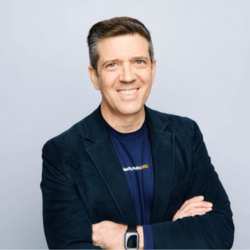
Dan is the Founder and CEO of the Health Podcast Library — this interview has been lightly edited for style and readability
James Cridland: You used to be called the Health Podcast Network, but now it’s called the Health Podcast Library. Why the change?
Dan Kendall: We changed a lot more than just the name. We changed the whole approach to what it is that we’re doing, at this intersection of healthcare and podcasting.
Podcast networks are really around a lot of things around IP monetization and production services. What we found working in the healthcare space is there are a lot of people don’t want that. They’re not looking to monetize their Johns Hopkins podcast or their Mayo Clinic or University of Pennsylvania. They’ve already got their own internal services for production. So, after we did the Health Podcast Summit last year, which you were a part of and I’m grateful for that, we realized there was a lot more that people needed just for discovery tools. And we decided to reframe our entire approach to our software.
We chose the name Health Podcast Library because libraries for centuries have been the houses where science and knowledge has been shared with the public. We thought that’s precisely what we’re trying to do through podcasts. We’re trying to create a curated collection of information that can be accessed by people who are searching for science and medical and health knowledge. And we’re putting that all in one place under the Health Podcast Library umbrella.
JC: And of course, a library is a curated experience, as you so rightly say. If you’re there looking for health podcasts in general, is there an obvious way to know what’s real and what’s quackery for for clicks?
DK: That’s one of the big challenges right now, just broadly across all of society - really knowing whether somebody credible is behind what you’re listening to, whether that’s being generated by AI, whether it’s being elevated to you by an algorithm.
I’m kind of embarrassed to say that one of the chief exports from America right now is an anti-science agenda. We’re seeing it all over the globe. And a lot of it is happening right here at home as we see just a pullback on international participation in a variety of clinical and scientific communities. We’re seeing pullback on grants and scientific funding in the US. The US used to be a destination for a lot of the best minds around the world to come and do their research and develop their products. And unfortunately, that isn’t happening right now. So we’ve got AI algorithms and an anti-science agenda working against us, and particularly in healthcare, where again in the US, we’re seeing a lot of cutbacks on rural health, we’re seeing a lot of closures of hospitals, consolidation, rising costs. It’s creating an opportunity to try to fill that information void and to say, how are we going to get this information out to the soft tissue between people’s ears so that they can actually understand how to take care of themselves, how to take care of the people in their communities or take care of the people in their families.
When I talk to various healthcare organizations that are making podcasts, they say, “well, we don’t really need anything else because we’ve already got our podcasts on Apple and Spotify and YouTube, and they’ve got huge reach”. I did an example with one of the top hospitals in the world. We did a search across those platforms, and we had their podcasts on Health Podcast Library as well. They did not feature in any of those three platforms when we put in the search terms that they wanted to be found for. And then we went to Health Podcast Library, they were there.
You think that Apple is helping you find and reach your audience? It’s not. Spotify, YouTube, the same thing. You want people to hear this content before they come in to seek treatment. Of the 50 shows that Apple just presented to me, which one of these do you want me to listen to before I come in and see your healthcare professionals?
We’re not trying to keep people away from putting their podcasts on those platforms. We want people to be discovered there. But we’re saying, look, let’s create a separate environment where we can have a smaller set of shelves where we can curate the books that are there and make it easier for people to find the information that they’re looking for.
JC: What’s the business model behind it? Are podcasts paying to go into the library, or how does it work from that point of view?
DK: We changed our whole model as we moved away from Health Podcast Network. In the Health Podcast Network, we were charging people. And that was an obstacle to try to overcome that whole explanation about why it was worth supporting something like what we were doing.
When I wanted to focus on health podcast libraries, I realized that I had to do two things. Number one, at the center of everything we do is the person we’re trying to reach. That can be patients, that can be a healthcare provider, that can be someone like me that was working in the healthcare industry that was trying to create products and services and solutions to empower hospitals and caregivers and patients in better ways. So if I want to keep the person at the center of that focus, I need to make it free for them, carte blanche. It absolutely has to be free. I cannot put a paywall in front of that listener, that perspective listener of accessing their information. And similarly, if I’m really focused on serving their interests, I can’t then turn to a creator and say, I’m gonna give you access to this audience, but only if you pay me, because that undermines the first principle, which is I want to make sure that the people who are searching for information have free and open, unfettered access to the best information that will help them reach the best health that they’re possible of attaining. So it’s free for listeners, free for creators.
So how are we actually monetizing? We’re not placing ads. We are working with sponsors. We do have some paid plans. So the free version of Health Podcast Library does the same as Apple and Spotify, but more. It gives them the same sort of visibility. They don’t have to change their hosting. We pull in the RSS feed just like another destination, gives them visibility and their episodes and their artwork. We want to make sure everybody has access to that. Whenever someone follows a show on Health Podcast Library, whenever that show publishes a new episode we send them an email. And in the health community, people are not habitual podcast listeners like you and I are. So we want to make sure that we have an opportunity of after we’ve engaged their interest and they’ve said they’re interested in this, we want to make sure that we’re not relying on push notifications on Apple or Spotify to actually reach their attention a second time. So we we set up this email service. So all that’s available for free.
For the paid levels, we’re developing new solutions that frankly are way overdue, I believe. People are trying to say, “find us wherever you find podcasts”. Well, it’s hard to find some of these things. A lot of them are by the same name, or you just put in a word and you end up with 50 results, and you’re not sure which one was the actual one that your friend told you about or that you heard before. So we’re creating more tools where people can put in custom buttons, and embed their own YouTube playlists.
And, create their own bios - because this is really important. Who are the people behind this? Apple and Spotify don’t really make it very easy for somebody to put in their host bio or their team bio. Who else is behind this doing research or production? And and all that’s visible again on a paid plan.
And what we’re doing on the Health Podcast Library is we’re including links to whatever platforms the creators want to make available to their audience. It’s almost like a LinkTree where they can go and use that. People can find it and then find the links to their favorite platforms, or they can listen right there.
And we’re we’re also creating the ability for people to have playlists, to filter shows into specific areas - to curate that content in a meaningful way. People can then take that playlist and share that out and say, hey, this is something that I think you should listen to. And we’re having a lot of interest from healthcare professionals around that very thing as their time with patients continues to get restricted from eight to 15 minutes and seeing patients one after another. We need to give them tools to be able to say, this is how you can engage outside of the clinic setting. And this is where you can listen to this on the way home. You don’t have to read anything, you don’t have to watch a video and put your attention on a screen. You can literally scan this QR code on my screen and walk out and start listening to this on the drive home or the commute back and begin to get that information that’s going to make you more empowered.
JC: Thank you so much. And thank you for your support as well.
DK: I love what you’re doing, James. I’ve been a big fan for years, and I appreciate the opportunity to speak with you here.